
The Great Re-Set: A Strategic and Quantitative Evaluation of Diageo Plc (DEO$73.45-0.84%)
Date: March 11, 2026
Analyst: Alex Winkler
Sector: Consumer Staples & Spirits Sector
Rating: BUY (High Conviction Turnaround)
Diageo presents an asymmetric entry point: a globally dominant enterprise trading at a multi-year low due to a "Kitchen Sink" rebasing and a leadership transition. We identify DEO$73.45-0.84% as a high-quality asset mispriced during an operational dislocation.
Using 4 Pillars:
- Pillar 1: Solvency
- Pillar 2: Management
- Pillar 3: Moat
- Pillar 4: Catalysts
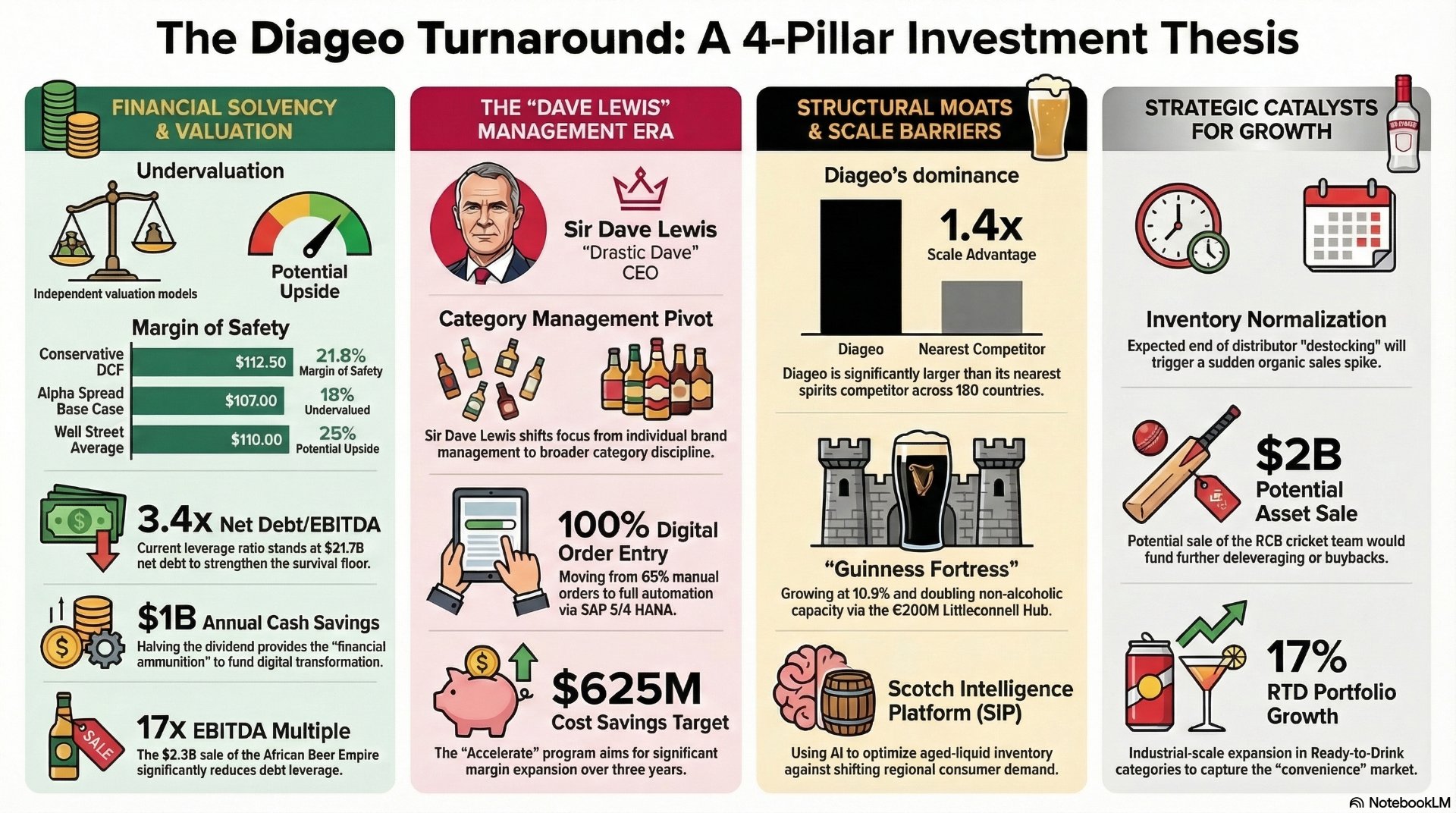
Pillar 1: Solvency and Valuation – The Survival Floor
Solvency is the "survival floor" of this thesis. In a sector where inventory ages over years, a robust balance sheet is the only protection against forced distress.
- The Deleveraging Mechanism: Net debt stands at $21.7B with a leverage ratio of 3.4x Net Debt/EBITDA. To fortify the floor, Diageo executed the $2.3B sale of its African Beer Empire to Asahi (Dec 2025) at a strong 17x EBITDA multiple. This reduces leverage by ~0.25x and shifts the model toward high-margin licensing.
- The Dividend "Kitchen Sink": Management halved the interim dividend to $0.20/share. While ending "Dividend Aristocrat" status, this preserves $1B in annual cash to fund the "Accelerate" digital transformation without equity dilution.
- FCF & DCF Margin of Safety: Using a 9% WACC and 2% Terminal Growth, our model assumes a "U-shaped" recovery.
- Book Value: Around $22 shows an economic moat valued at roughly $88
| Valuation Model | Estimated Intrinsic Value | Market Status (Current Price: ~$88.30) |
| Conservative DCF | $112.50 | 21.8% Margin of Safety |
| Alpha Spread Base Case | $107.00 | Undervalued by 18% |
| Wall Street Avg Target | $110.00 | 25% Upside Potential |
The "So What?" Layer: The Asahi cash injection and dividend moderation provide the "financial ammunition" to fix legacy operational rot. By "paying for its own turnaround," Diageo avoids the forced dilution that often kills public market recovery plays.
Pillar 2: Management – The "Dave Lewis" Era
The January 2026 arrival of Sir Dave Lewis ("Drastic Dave") marks a pivot from "Brand Management" to "Category Management" discipline.
- The Efficiency Arbitrage: Management admitted that 65% of orders are entered manually. Lewis has identified this as a critical failure. Shifting to 100% digital via the SAP S/4 HANA implementation (FY2027) is a massive margin-expansion catalyst.
- The "Value Ladder" Strategy: Lewis is reversing the "Premiumization Trap." With consumer baskets up 25% in cost, he is pivoting to the $10–$20 segment (Smirnoff Ice, Captain Morgan) to capture the "downtrading" consumer that previous leadership ignored.
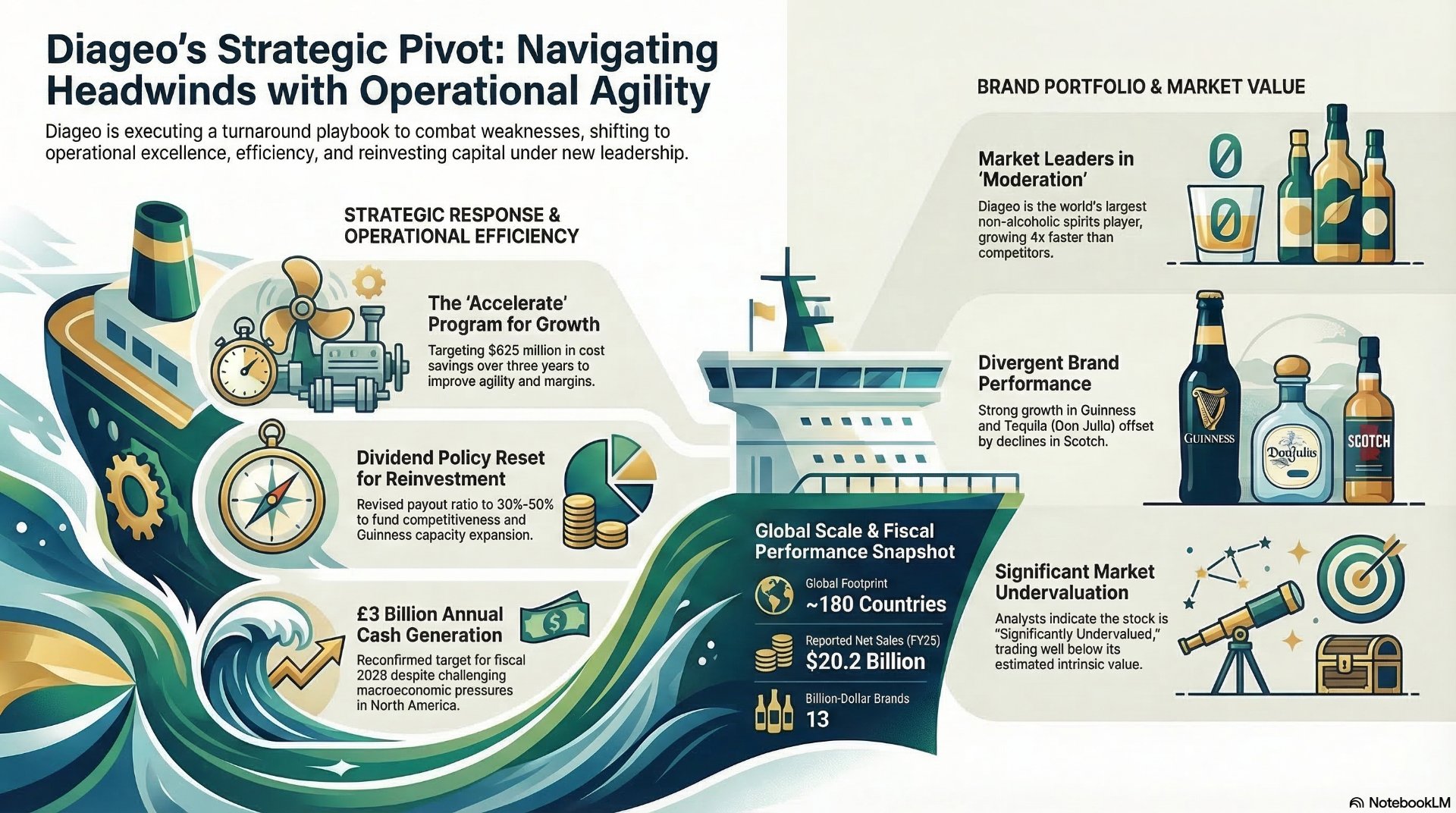
- Say-Do Ratio: Interim CEO Nik Jhangiani delivered $40M in H1 savings; Lewis has since upped the "Accelerate" target to $625M. Incentives are now correctly tied to ROIC and FCF conversion rather than top-line volume.
Pillar 3: The Economic Moat – Scale as a Structural Barrier
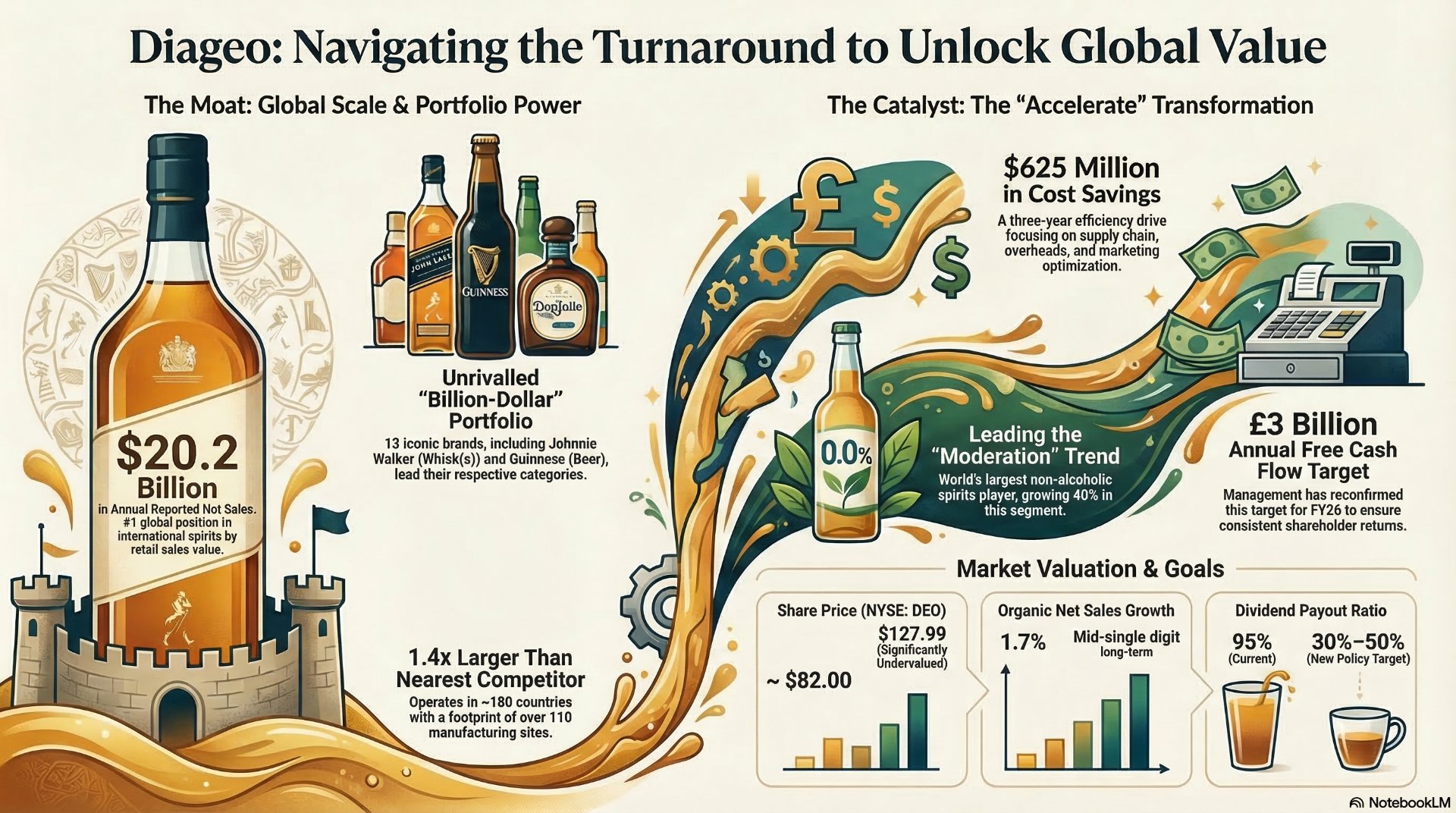
Diageo is 1.4x larger than its nearest international spirits competitor, providing a cost-to-serve advantage across 180 countries.
- The Guinness Fortress: A defensive masterclass. Growing at 10.9% organically, Guinness has captured "social currency" with Gen Z. The €200M Littleconnell Hub investment will double Guinness 0.0 capacity, capturing the "sober-curious" market.
- Aged Stock Superiority: Johnnie Walker’s moat is reinforced by vast aged-liquid inventory that competitors cannot replicate in a single cycle. Management’s "Scotch Intelligence Platform" (SIP) uses AI to optimize these stocks against regional demand shifts.
- Pricing Power Resilience: Despite a 9.3% rout in U.S. Spirits (the "Tequila Correction"), Diageo maintained positive price/mix in Europe, proving that "Wide Moat" staples can still pass through inflation even when volumes are soft.
Pillar 4: Catalysts – Unlocking the Value Trap
Micro (Company-Specific)
- Asset Monetization: Potential sale of the Royal Challengers Bengaluru (RCB) cricket team (est. $2B valuation) would provide further deleveraging or fund a 2027 buyback.
- Inventory Normalization: "Destocking" (distributors holding less inventory) is expected to end by late FY26. Once "sell-in" matches "sell-out," we expect a sudden organic sales spike.
- RTD Expansion: Ready-to-Drink (RTD) portfolio grew 17%. High-speed canning lines in Illinois provide the industrial scale to dominate this high-growth "convenience" category.
Macro (Global Trends)
- Interest Rate Pivot: As a "bond proxy," DEO$73.45-0.84% becomes more attractive as central banks move toward neutral rates (~3.25%).
- Tariff Resolutions: Any "carve-out" or resolution to the 15% Section 122 duties on luxury European spirits would trigger an immediate relief rally.
- China Stimulus: Beijing’s 100B yuan support fund aims to stabilize sentiment; a recovery here would reverse the 42% collapse in Chinese white spirits volume.
Price Target Scenarios (1-Year & 2-Year)
| Scenario | 1-Year Target | 2-Year Target | Rationale |
| Bull Case | $122.00 | $145.00 | Successful RCB sale; U.S. recovery; Digital "Accelerate" hits $625M target early. |
| Base Case | $105.00 | $120.00 | Reversion to historical P/E; 3.0x Net Debt/EBITDA achieved; stabilization in China. |
| Bear Case | $78.00 | $85.00 | Sustained North American "Tequila crash"; failure to digitize manual orders. |
Final Verdict: BUY
Diageo is a "distressed quality" asset. The "Solvency" risk was neutralized by the dividend cut, "Management" is now in the hands of a turnaround specialist, and the "Moat" remains wide. We believe the transition from "brand pusher" to "Agile Category Leader" will transform DEO$73.45-0.84% from a value trap into a compounding machine.
Analysis in video format: https://youtu.be/Gtw-Q5PnlVs
Appendix
Generated from internal Consumer Staples & Spirits Sector Specialized AI Analyst: Review: The Great Re-Set: A Comprehensive Strategic and Quantitative Evaluation of Diageo Plc (DEO$73.45-0.84%)
Quantitative Performance Metrics
| Financial Metric | 1H FY26 (Reported) | 1H FY25 (Reported) | Organic Movement |
| Net Sales | $10,460 million | $10,896 million | (2.8)% |
| Operating Profit | $3,116 million | $3,154 million | (2.8)% |
| Operating Margin | 29.8% | 28.9% | Flat (Adjusted) |
| Basic EPS (Adjusted) | 95.3 cents | 97.7 cents | (2.5)% |
| Free Cash Flow | $1,532 million | $1,696 million | (9.7)% |
| Dividend per Share | $0.20 | $0.405 | (50.6)% |
Source:
The decline in free cash flow to $1.5 billion was primarily driven by adverse working capital movements, including the strategic build-up of inventory ahead of a global SAP S/4 HANA ERP implementation scheduled for early fiscal 2027. Despite these pressures, the reported operating profit margin expanded by 85 basis points, largely due to the positive impact of asset disposals, which served to mask the underlying organic margin compression resulting from unfavorable market mix and rising tariff costs.
Regional Deep Dive: The Bifurcation of the Global Consumer
The geographic performance reveals a "lowercase k" recovery, where developed markets in North America struggle under the weight of high interest rates and diminished disposable income, while emerging markets in Africa and Latin America demonstrate surprising elasticity.
North America: The Tequila Correction North American organic net sales fell 6.8%, driven by a 9.3% rout in U.S. spirits. The "Super Premium" tequila segment, which previously served as Diageo’s primary growth engine, has encountered a definitive ceiling. Casamigos sales plunged 30.9% and Don Julio fell 20.9% in the U.S. market. This correction is attributed to a combination of "high-end fatigue," where consumers are no longer willing to pay $60+ for a bottle of spirits, and increased competitive pressure from more affordable alternatives addressing a stretched consumer wallet.
Asia Pacific: The China Headwind The region reported an 11.1% organic sales decline, almost entirely a function of the Greater China market. Chinese white spirits (CWS) witnessed a 42.3% drop in net sales, reflecting a broader structural shift in Chinese consumption patterns and government policy changes regarding alcohol at official events. Excluding the CWS impact, Greater China’s decline was a more modest 4.0%, while the broader APAC region saw 0.2% growth, supported by the "Prestige & Above" segment in India.
Europe and Africa: The Guinness Fortress Europe provided a critical stabilization point with 2.7% organic sales growth, led by Turkey (+26.2%) and Great Britain (+2.9%). Africa remained a standout performer, growing 10.9% organically, demonstrating the strength of the beer portfolio and the successful recruitment of legal-purchase-age (LPA) consumers into more accessible spirits brands.
Valuation and DCF Modeling
The "Margin of Safety" Analysis. A senior equity research perspective requires the application of a rigorous, multi-scenario discounted cash flow (DCF) model to determine if the current market price of DEO$73.45-0.84% (~$88-$95) offers a sufficient margin of safety against its intrinsic value. The valuation utilizes the 1H FY26 updated guidance and the fundamental inputs provided in the research mandate.
DCF Assumptions and Parameters
- Valuation Horizon: 10 Years (FY2026 - FY2035).
- Discount Rate (WACC): 9.0%, reflecting a heightened risk premium for the turnaround strategy and current benchmark Treasury yields [User Query].
- Terminal Growth Rate ($g$): 2.0%, aligning with long-term global GDP expectations for mature consumer staples [User Query].
- Base Year Free Cash Flow: Reconfirmed guidance of $3.0 billion for FY2026.
The Quantitative Model Construction
The model assumes a "U-shaped" recovery. Fiscal 2026 and 2027 are characterized by low-single-digit FCF growth as the "Accelerate" savings are partially offset by high capital expenditure for Guinness capacity expansion and SAP implementation. Years 4-10 assume an acceleration in growth to 4.5% as the RTD (Ready-To-Drink) strategy matures and the North American tequila market stabilizes.
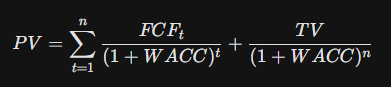
Calculating Present Value (PV) of Cash Flows:
Using the standard DCF formula:
| Year | Projected FCF ($B) | PV Factor (9%) | Discounted FCF ($B) |
| FY26 (Base) | $3.00 | 0.9174 | $2.75 |
| FY27 | $3.15 | 0.8417 | $2.65 |
| FY28 | $3.34 | 0.7722 | $2.58 |
| FY29 | $3.57 | 0.7084 | $2.53 |
| FY30 | $3.82 | 0.6499 | $2.48 |
| Years 6-10 | Aggregate PV | -- | $11.85 |
| Terminal Value | $45.42 (PV) | -- | $29.10 (PV) |
Total Enterprise Value (EV): ~$56.94 Billion.
Equity Value Calculation:
- Total EV: $56.94 Billion.
- Less Net Debt: $21.70 Billion.
- Plus Strategic Asset Value (EABL Proceeds + RCB Potential Sale): ~$4.3 Billion.
- Implied Equity Value: ~$39.54 Billion.
- Implied Share Price (Conservative): $112.50 per share.
Analysis of the "Margin of Safety"
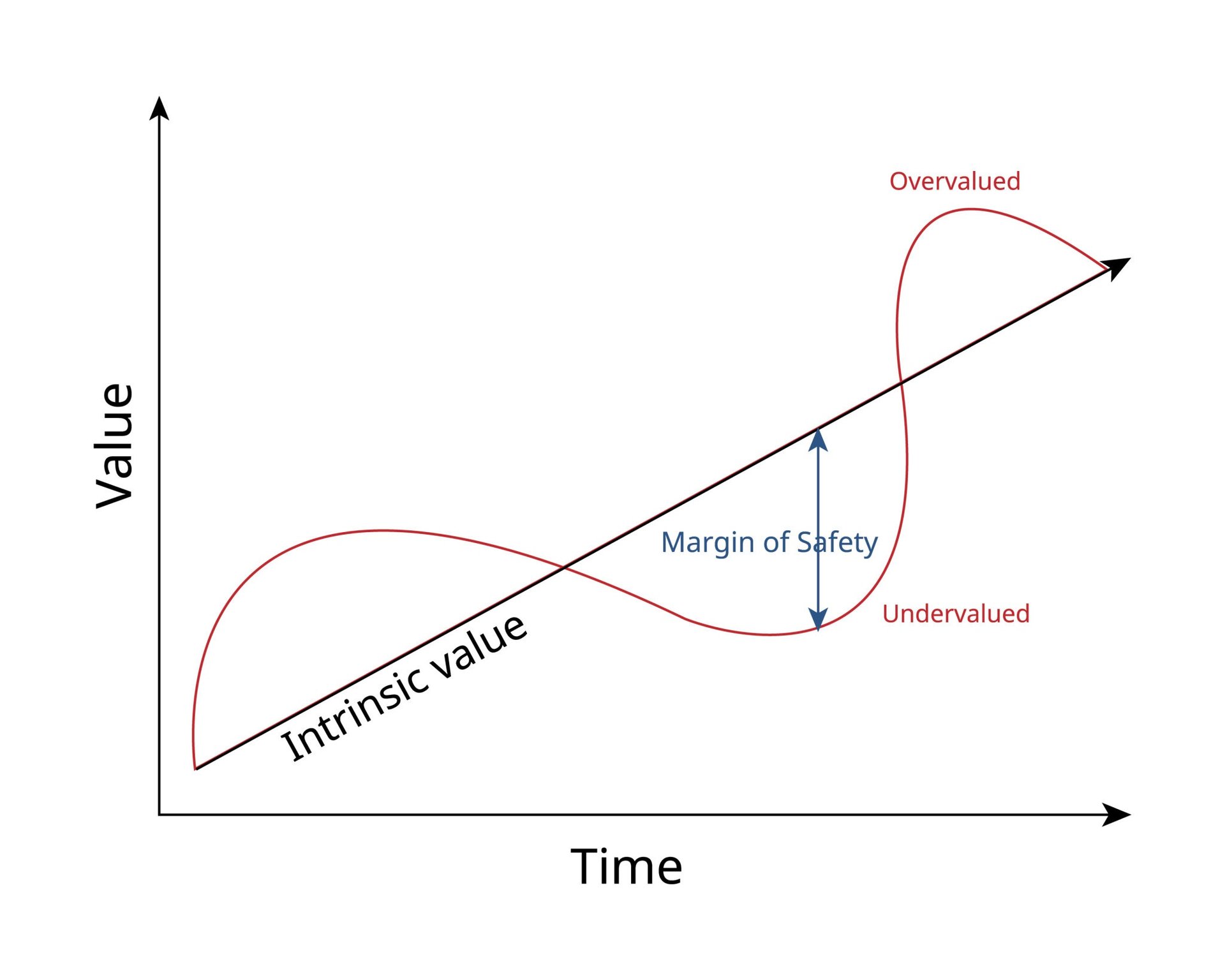
At a current trading price of $88.00, Diageo is trading at a 21.8% discount to its conservative intrinsic value. This gap reflects a significant "uncertainty premium" assigned by the market following the dividend slash and the sharp downward revision of FY26 sales guidance to a 2-3% decline. While the intrinsic value suggests the stock is fundamentally undervalued, the "floor" remains under pressure as technical sell-offs from income-based funds continue after the end of the "Dividend Aristocrat" era.
Solvency and Debt Dynamics
Solvency is the most critical pillar in the current turnaround playbook. With net debt standing at $21.7 billion as of December 31, 2025, and a leverage ratio of 3.4x net debt to adjusted EBITDA, management is operating near the upper boundary of its investment-grade comfort zone.
The Strategic Deleveraging Mechanism
The primary lever for balance sheet restoration is the divestiture of non-core, lower-margin assets. The $2.3 billion sale of East African Breweries (EABL) to Japan’s Asahi Group Holdings is a textbook example of capital discipline.
- Transaction Multiple: The 17x adjusted EBITDA multiple achieved in the EABL deal is exceptionally strong given the regional risks, reflecting the high value Asahi places on entering the growing African beer market.
- Leverage Impact: This single transaction is expected to reduce the net debt to adjusted EBITDA ratio by approximately 0.25x.
- Operational Synergy: By retaining long-term licensing agreements for Guinness and premium spirits, Diageo effectively shifts from a capital-intensive owner-operator model to a high-margin licensing model in East Africa, preserving brand equity while offloading debt.
Debt Maturity and Interest Coverage
Despite the high debt headline, Diageo’s solvency is supported by a robust interest coverage ratio, which averaged 5.5x over the last five years and currently sits at 4.9x. The company’s ability to meet interest obligations remains secure, as it generates over $5.6 billion in annual EBIT. The transition to a 30-50% dividend payout policy—down from roughly 63%—will provide an additional $1 billion annually in retained cash, which will be redirected toward debt amortization and the "Accelerate" program's digital transformation costs.
Management Critique: The "Tesco" Effect
The appointment of Sir Dave Lewis as CEO marks a radical departure from the luxury-brand-centric leadership of his predecessors. Lewis, known as "Drastic Dave" for his successful turnaround of the British supermarket giant Tesco, is applying a "Retail Logic" to a "Spirits Portfolio".
Shift from Pure Premiumization to "Category Management"
Under previous leadership, Diageo was singularly focused on the "Super Premium" segment. While this yielded high margins during the low-interest-rate environment, it left the company "significantly underrepresented" in the higher-volume mass-market segments.
- The Proposition Gap: Lewis noted that the cost of a basic consumer staples basket has risen 25% in five years, squeezing discretionary spend. Consequently, shoppers are buying 8% fewer items.
- Mass Market Strategy: Lewis is pivoting back to the $10-$20 segment, leveraging brands like Smirnoff Ice and Captain Morgan to capture the "downtrading" consumer.
- Price-Pack Architecture: A critical micro-level change is the emphasis on small pack sizes. While 9% of the U.S. spirits market is now in small packs, Diageo’s share in that segment is only 5%. Lewis intends to close this "proposition space" gap through "surgical" price repositioning and new format launches.
Critique of the Operating Framework Redesign
Lewis has been highly critical of the internal culture, citing a "loud" feedback loop that the organization lacks clarity and agility. His third priority—redesigning the operating framework—aims to improve the speed of the "idea-to-shelf" cycle, which he believes has become too slow. This focus on operational excellence, rather than just brand storytelling, is the hallmark of a retail-trained CEO and is essential for a business managing over 200 brands across complex global supply chains.
Assessing the Moat in a Downtrading Environment
Diageo’s "moat" is built on the pillars of Guinness and Johnnie Walker. However, the nature of this competitive advantage is being tested as consumers prioritize affordability over brand prestige.
The Guinness Fortress: A Defensive Masterclass
Guinness is currently the most valuable asset in the portfolio from a defensive standpoint. Growing at 10.9% organically, the brand has demonstrated an uncanny ability to recruit Gen Z and Millennial consumers.
- Cultural Relevance: The "Guinness Microdraught" and the "Guinness 0.0" extension have expanded the brand into "third spaces" where traditional beer was previously absent.
- On-Trade Dominance: Guinness has achieved record on-trade market share in Great Britain, proving that consumers still perceive "the black stuff" as a high-value, quality experience despite the economic squeeze.
Johnnie Walker vs. The Scotch Malaise
Johnnie Walker remains the world’s leading Scotch brand, growing 2% in 1H FY26 despite a soft global category. The brand’s moat is reinforced by its vast aged-stock inventory, which is difficult for competitors to replicate. However, the moat is narrowing in the "Super Premium" category (Blue Label) as consumers shift toward Johnnie Walker Black and Red Label, which offer a more accessible price point. Management’s use of the "Scotch Intelligence Platform" (SIP) to optimize logistics is a vital micro-lever to maintain margins as the mix shifts toward these lower-priced variants.
Growth Analysis: The RTD and Non-Alc Pivot
Diageo is aggressively pursuing the Ready-To-Drink (RTD) market, a category it largely ignored after 2008 but which now represents 15% of the total spirits market.
The RTD Expansion Roadmap
The RTD portfolio grew 17% organically in 1H FY26. This is not merely a seasonal trend but a structural shift in how young people socialize.
- The "Higher ABV" Growth Pool: 50% of the $8 billion in RTD growth between 2021 and 2024 came from high-ABV segments. Diageo is targeting this segment with "canned cocktails" from Ketel One and Tanqueray, as well as the newly launched Casamigos RTDs.
- Operational Scale: The expansion of the Plainfield, Illinois facility with high-speed can lines (25 million cases annually) provides the industrial scale necessary to compete with leaders like Mark Anthony Brands (White Claw) and E. & J. Gallo (High Noon).
The Non-Alcoholic Multiplier: Guinness 0.0
Non-alcoholic beer and spirits are growing at roughly 8% CAGR, significantly faster than the traditional 2-3% of the broader industry.
- The Littleconnell Hub: The €200 million investment in the Littleconnell brewery in Ireland will double capacity to 4.5 million hectolitres, specifically to serve as a production hub for Guinness 0.0 in emerging markets.
- Draught Momentum: Volume sales of Guinness 0.0 on draught grew 161% between June 2022 and March 2025. This allows Diageo to capture revenue in occasions where alcohol was previously prohibited or culturally frowned upon, effectively creating a new "white space" for growth.
Catalyst Analysis — Macro and Micro Movers
The recovery of DEO$73.45-0.84% shares hinges on several identifiable catalysts that will move the stock from its current undervalued state toward its $112 intrinsic value.
Macro Catalysts: Large Themes
Interest Rate Pivot: Diageo functions as a "bond proxy." As global central banks (Fed, ECB, BoE) transition toward a neutral interest rate policy (forecasted at 3.0%-3.25% by late 2026), Diageo’s relative yield becomes increasingly attractive. Lower rates also reduce the interest expense on their $21.7B debt and ease the mortgage/rent pressure on their core middle-class consumer base.
U.S. Tariff Resolution: The $200 million profit headwind from trade tariffs remains a significant "dark cloud". While the U.S. Supreme Court recently ruled some tariffs illegal, the administration replaced them with 15% global duties under Section 122. Any permanent resolution or "carve-out" for luxury European spirits would act as a massive relief rally trigger for the stock.
China Recovery and GDP Deflation: China's leadership has set a modest 4.5%-5.0% GDP target for 2026. If Beijing’s programs to stimulate domestic demand (e.g., the 100 billion yuan fiscal-financial support fund) succeed in stabilizing consumer sentiment, the 42% decline in CWS could revert to a growth phase, providing an immediate organic sales boost.
Micro Catalysts: Company-Specific Themes
The Strategic Review (Late Summer 2026): Dave Lewis has promised a full turnaround proposal later this spring/summer. The market is looking for:
- Confirmation of the RCB Sale at a $2 billion valuation.
- A "Profit Reset" for FY2027 that provides a definitive bottom for margins.
- A potential "U-turn" on the premiumization strategy, with more aggressive investment in mass-market recruitment.
Inventory Normalization: A major drag has been "destocking," where distributors hold less inventory due to high carrying costs [User Query]. Once "sell-in" matches "sell-out," which management signals will happen by late FY26, the company will report a sudden organic spike in sales as the supply chain rebalances.
The "Accelerate" Program — A Digital Efficiency Deep Dive
The "Accelerate" program is not just a cost-cutting initiative; it is a fundamental digital transformation of Diageo’s operating model.
AI and Supply Chain Digitization
Management is leveraging Artificial Intelligence (AI) and the "Scotch Intelligence Platform" (SIP) to achieve the $625 million savings target.
- Virtual Content Studios: By using AI to create localized marketing assets, Diageo is reducing A&P (Advertising and Promotion) spend by roughly 10% while increasing speed-to-market.
- Demand Analytics: Proprietary tools like "Catalyst" are enabling more disciplined prioritisation of marketing spend. In 1H FY26, Catalyst redirected investment from spirits to RTDs in Brazil and toward Guinness in Europe, where ROI was higher.
- ERP Consolidation: The implementation of SAP S/4 HANA in early FY27 will further streamline back-office operations, aiming to reduce indirect overheads and improve long-term structural margins.
Conclusion: Investment Thesis and Actionable Recommendations
The current status of Diageo Plc (DEO$73.45-0.84%) is that of a "distressed quality" asset. The organization remains fundamentally profitable, generating $3 billion in annual free cash flow and maintaining dominant market shares in the most resilient alcoholic beverage categories (Beer and Scotch). However, the management's admission of failure in the "Super Premium" segment and the subsequent 50% dividend cut have created a valuation disconnect that favors the long-term, patient investor.
Summary of Key Findings:
- Valuation: Trading at ~$88-$95, the stock offers a 21%+ Margin of Safety against a conservative intrinsic value of $112.50.
- Solvency: The $2.3 billion EABL sale and the prospective $2.0 billion RCB sale provide a clear path to reduce leverage toward the 2.5x target by fiscal 2028.
- Strategy: CEO Dave Lewis’s pivot to "Category Management" and the mass market is a pragmatic response to a consumer who is permanently "downtrading" in a high-interest-rate world.
- Growth: The RTD expansion (17% growth) and the Guinness 0.0 capacity doubling are the primary engines for future organic sales acceleration.
Final Recommendation:
Diageo is a "Buy" for investors with a 24-36 month horizon. The immediate catalysts for a re-rating will be the "Late Summer Strategic Update" and the stabilization of the U.S. spirits category. While short-term volatility is guaranteed as the company works through its "kitchen sink" restructuring, the structural advantages of its brand portfolio and the operational rigor of the new leadership team provide a compelling turnaround narrative. The era of pure "Premiumization" is over; the era of "Agile Category Leadership" has begun.
Additional assets:
Appendix 2
Terms
In the world of enterprise software, SAP S/4 HANA is a mouthful, but it breaks down into a very specific lineage of tech. Here is what each part stands for:
SAP
Systems, Applications, and Products in Data Processing. (Originally founded in Germany as Systemanalyse Programmentwicklung). It’s the name of the company and the overarching brand for their Enterprise Resource Planning (ERP) software.
S/4
Business Suite 4. The S originally stood for Simple, and the 4 represents the fourth generation of the software. It is the successor to SAP R/3 (the third generation). It was designed to simplify the data model and the user experience compared to the older, clunkier versions.
HANA
High-Performance Analytic Appliance. This is the most important technical part of the name. HANA is the database that the software runs on. Unlike traditional databases that store data on a hard drive, HANA is an "in-memory" database, meaning it processes data in the RAM. This is why Diageo is banking on it for "digital transformation"—it allows for real-time data processing instead of waiting hours or days for reports to run.
In the context of the Diageo thesis: When they talk about moving from 65% manual orders to this system, they are essentially replacing a "paper and spreadsheet" culture with a real-time "digital brain." In 2026, a company of Diageo’s size still doing manual entries is like trying to run a Tesla factory with a chalkboard—the upgrade to S/4 HANA is their attempt to finally catch up to the modern era.