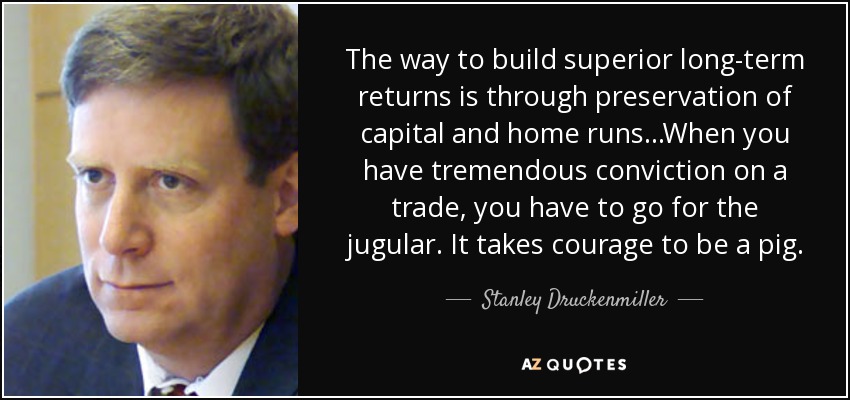
I just spent an hour deconstructing Stan Druckenmiller’s latest interview, and one thing became crystal clear: The greatest macro trader of our time doesn’t win because he’s a genius. He wins because he’s a “trigger puller.”
Even after three decades of 30% annualized returns, Druckenmiller, a man who has never had a losing year, still admits to throwing up from anxiety during drawdowns. It’s a refreshing, almost jarring bit of honesty in an industry filled with “alpha” posturing.
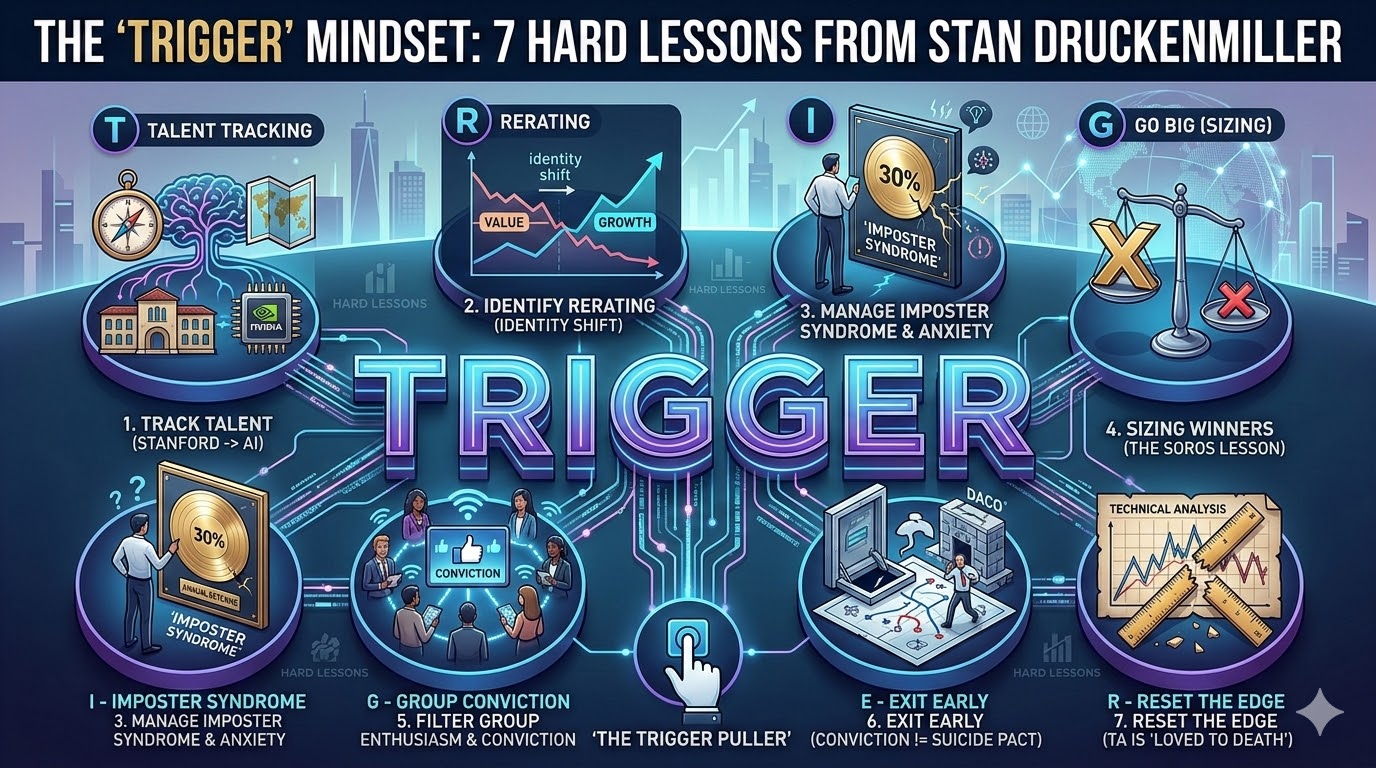
If you think you need a 160 IQ to win at macro, you’re looking at the wrong metrics. Stan himself admits he wasn’t in the top 10% of his class. His edge is a specific framework I’ve reorganized into the acronym TRIGGER.
Here is the breakdown of how to think like Druck.
T — Talent Tracking
“Where are the kids going?” Druckenmiller caught NVIDIA not by staring at a P/E ratio, but by watching the “network effect” of human capital. He noticed that the smartest students at Stanford were shifting 100% of their focus from Crypto to AI.
In the venture world and the public markets, talent is the ultimate leading indicator. Forget the charts for a second; follow the brainpower. If the smartest people in the room are pivoting, the capital will eventually follow.
R — Rerating
Look for the “Identity Shift” in a stock. His recent play on TEVA$28.34-1.39% is a masterclass in this. He didn’t buy it because it was “cheap” (though it was, at 6x earnings). He bought it because it was undergoing a transition from a boring generic drug company to a growth-oriented biotech firm under new leadership.
The goal is to find the gap where the “Value” investors are selling because they don’t like growth strategies, but the “Growth” investors haven’t arrived yet. That’s where the massive rerating happens.
I — Imposter Syndrome
Accept the mental scars. This was the most human part of the interview. Stan admitted to feeling like a “random accident” for over 15 years. He suffered from imposter syndrome long after he was a billionaire.
The lesson? You don’t need to be fearless to be a great trader. You just need to be able to act while you’re afraid. The scars from your past losses aren’t baggage; they are the “wisdom” that keeps you from making the same mistake twice.
G — Go Big (The Soros Lesson)
Sizing > Strategy. This is the lesson Stan learned from George Soros, and as a professional trader for the last 6 years, it’s the one I keep coming back to. It’s not about how often you are right; it’s about how much you make when you are right.
If your big winner isn’t properly sized, it won’t move the needle on your portfolio. As Stan says, “It’s about how much you lose when you’re wrong and how much you make when you’re right.” Most people are too small on their best ideas and too big on their “maybe” trades.
G — Group Conviction
Filter for enthusiasm, not just data. You don’t need to be a biotech expert or a master of genetic sequencing to trade those sectors. Stan relies on a “group” of specialists. But he doesn’t just read their spreadsheets; he filters for their enthusiasm.
When he sees an expert he trusts getting genuinely excited, that is his signal to pull the trigger. He manages the people and the “conviction,” while they manage the data.
E — Exit Early (Meet Mr. DACO)
Conviction is not a suicide pact. Druckenmiller calls himself “Mr. DACO” aka Druck Always Chickens Out (Joke on TACO). He might enter a trade with a 3-year thesis, but if the facts shift 5 days later, he is gone.
New traders get married to their ideas. Legends get married to their capital. If the “room energy” shifts, get over yourself and move on.
R — Reset the Edge
Technical Analysis is “loved to death.” One of the most controversial points Stan made was that Technical Analysis (TA) is about 20% as effective as it was 30 years ago. Why? Because now everyone is doing it.
When a pattern becomes consensus, the edge disappears. You have to constantly ask yourself: Is my signal still unique, or is it being loved to death by the crowd? If the crowd is right 80% of the time, make sure you aren’t standing there for the 20% when they get their heads handed to them.
The Bottom Line
The game of investing isn’t about being the smartest person in the room. It’s about being the one who recognizes when the room energy has shifted and having the guts to pull the trigger… even when you feel like throwing up.
For me, mastering the first G (Go Big) is a lifelong challenge. Refining the ability to size up into a winner is what separates a good year from a career-defining one.
Which letter is missing from your process right now?